Mpact is Southern Africa’s largest paper and plastics packaging and recycling business, with activities spanning recycling, paper manufacturing and converting, and plastic packaging production. Trace-metal analysis plays a key role in supporting Mpact’s regulatory compliance requirements.
THE CHALLENGE: A TIME-CONSUMING MANUAL CLEANING PROCESS
Mpact must verify very low concentrations of regulated metals, including Al, Sb, As, Ba, Cd, Cr, Co, Cu, Eu, Gd, Fe, La, Pb, Li, Mn, Hg, Ni, Tb and Zn, in accordance with Commission Regulation (EU) No 10/2011, amendment 2026/245, as well as BfR Recommendation XXXVI for Paper and Board for Food Contact, which sets specific limits for Pb, Cd and Al.
At such low concentration levels, contamination control becomes a critical part of the analytical workflow. Any residual trace metal left on glassware or laboratory accessories could affect the results and compromise the laboratory’s ability to demonstrate that packaging materials comply with the applicable limits.
Before implementing traceCLEAN, the laboratory relied on a conventional manual acid-cleaning procedure. Glassware and accessories had to be soaked for extended periods using relatively large quantities of concentrated acids, before being manually removed, rinsed and dried.
This method presented several important challenges. From a safety perspective, laboratory personnel had to handle substantial volumes of corrosive acids and work close to potentially harmful acid vapours. The repeated transfer, rinsing and disposal steps increased the risk of operator exposure, accidental spills and contact with hazardous chemicals.
The process also had a significant economic and environmental impact. Large quantities of acid had to be purchased to maintain the cleaning procedure, while the spent acid generated additional costs for collection, treatment and disposal. As hazardous chemical waste, it had to be managed according to strict safety and waste-disposal requirements.
In addition, the manual procedure was time-consuming and involved several handling steps, increasing the possibility of cleaned components being recontaminated during transfer, rinsing or drying.
Mpact therefore needed a safer and more controlled cleaning method that could reduce acid consumption, minimise hazardous waste generation and protect laboratory personnel, while providing the cleanliness required for reliable trace-metal analysis.
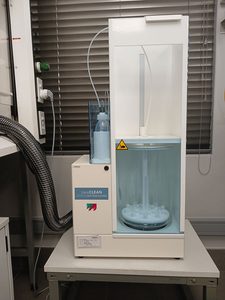
The solution: automated acid-steam cleaning with traceCLEAN
Mpact selected the Milestone traceCLEAN, an automated and self-contained acid-steam cleaning system designed for glassware and accessories used in trace-element analysis.
Unlike conventional soaking methods, traceCLEAN uses freshly distilled hot acid vapours to clean the surfaces of laboratory components. During the cycle, the vapours condense on the items and remove trace-metal residues, which are then collected in the lower section of the system. This keeps the contaminants physically separated from the cleaned components.
The operator simply loads the items into the system, adds the required amount of acid and starts the selected cleaning programme.
The entire process takes place inside a sealed chamber, minimising the need to transfer or manually handle components during cleaning. At the end of the program, the laboratory items are perfectly clean. They can also remain inside the closed system until they are required, helping protect them from airborne contamination.
Results and benefits
The introduction of traceCLEAN has made the cleaning process faster, safer and more economical for the Mpact laboratory.
One of the main benefits is the significant reduction in acid consumption. Compared with the previous soaking method, Mpact estimates an acid reduction of around 90%: cleaning a batch of glassware previously required approximately 5 L of acid, while traceCLEAN requires only about 500 mL. This has substantially reduced both the cost of purchasing concentrated acids and the costs associated with their treatment and disposal as hazardous waste.
The system is also extremely simple to operate. Laboratory personnel load the glassware and accessories into the unit, add the required amount of acid, close the system and start the program. The cleaning cycle then runs automatically, without the need for continuous operator supervision.
The cleaning process is also much quicker. A complete cleaning cycle takes approximately 90 minutes, allowing glassware and accessories to be returned to service after they cool to room temperature. The overall process is significantly faster than with prolonged acid soaking.
The closed and automated process considerably reduces the risk of operators being splashed with concentrated acids or exposed to acid vapours during cleaning, transfer and rinsing operations.
Because the components are cleaned inside a closed system, the risk of cross contamination is substantially reduced. This is particularly important for Mpact, where reliable trace-metal results are essential for demonstrating compliance with food-contact regulations.
Overall, traceCLEAN has provided Mpact with:
- around 90% lower acid consumption;
- reduced acid purchasing and disposal from approximately 5 L to 500 mL;
- less hazardous chemical waste;
- improved operator safety;
- a simple, automated cleaning procedure;
- reduced risk of cross-contamination;
- faster availability of clean laboratory components.
By combining efficiency, safety and consistent cleaning performance, traceCLEAN has helped Mpact improve its laboratory workflow while supporting the reliability of its trace-metal analyses.
“Regarding reduction of acid consumption, I would estimate 90% reduction. It definitely improved our workflow in the lab.”
Said Pauline Skillington, Laboratory Systems Lead at MPACT
Latest Articles

Mastering Geological Sample Preparatione

Keep Your ETHOS Digestion Rotor in Top Condition with Regular Inspection
