How microwave technology enabled a new green pathway at the University of Brescia for lithium recovery from black mass
Battery production is growing rapidly to meet the strong demand and use in diverse applications such as portable electronics and electric vehicles. Therefore, considerable attention is paid to ensuring the sustainability of the critical raw materials used in their production, given limited natural reserves and their distribution.
Lithium and cobalt are considered critical raw materials because they are in short supply, but also strategic because they are essential for the energy transition. Currently, only 5% of lithium is recycled globally.
In nature, extracting one ton of lithium requires 250 tons of environmentally harmful minerals or 750 tons of brine, and current technologies for recycling these metals are very expensive and polluting.
The rapid expansion of electric mobility and the increasing demand for lithium-ion batteries have intensified the global challenge of ensuring sustainable access to critical raw materials. Among these critical raw materials, lithium stands at the core of modern energy storage. As battery production rises, so does the imperative to recover lithium efficiently and responsibly from end-of-life cells. Traditional recycling routes are often based on strong mineral acids or high-temperature pyrometallurgy and pose environmental, safety, and economic drawbacks that limit their long-term scalability.
Against this backdrop, a research group at the University of Brescia, under the scientific guidance of Professor Elza Bontempi, has developed an innovative and environmentally responsible method for lithium recovery from black mass (BM), the powdered residue obtained from the mechanical treatment of spent lithium-ion batteries.
The research team, known as Tech4Lib, currently operates under a dedicated ministerial grant named “Caramel”. This research proposes a paradigm shift: instead of relying on harsh chemical treatments, the process leverages microwave energy as the core enabling technology to activate and transform the material, making lithium selectively recoverable through a greener approach.
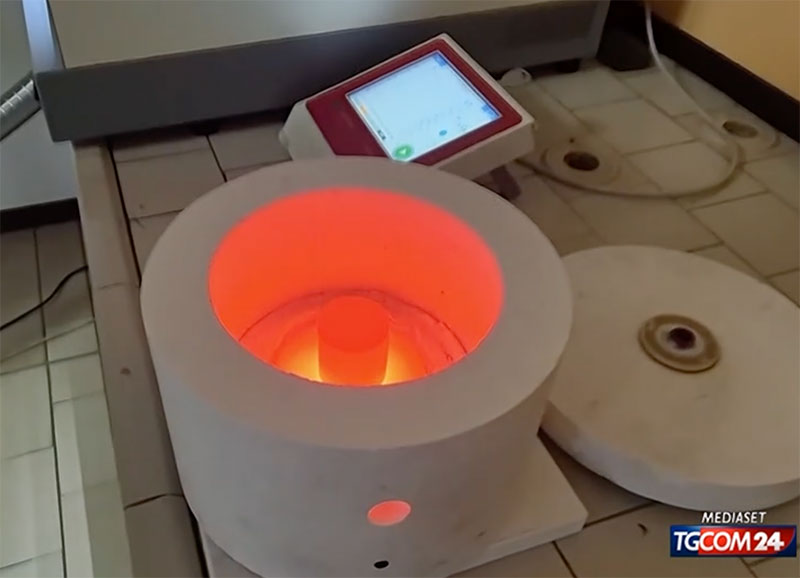
Microwave Processing at the core
A central element of this breakthrough lies in the use of the PYRO Advanced Microwave Muffle Furnace by Milestone. Thanks to its ability to deliver rapid, homogeneous and precisely controlled heating, the PYRO system enabled the team at the University of Brescia to induce a targeted transformation inside the black mass.
The BM naturally contains graphite, which becomes an active agent when exposed to microwaves. Under PYRO’s microwave irradiation, the graphite initiates a carbothermic reduction, converting the lithium-containing compounds into lithium carbonate (Li2CO3).
This microwave-enabled shift in phase composition represents the true turning point of the methodology. It offers a valuable alternative to aggressive chemical leaching, by assuring an advanced microwave heating, accurate temperature control, and high operator safety. With PYRO, the University of Brescia researchers were able to bypass limitations of hydrometallurgy and pyrometallurgy and implement a remarkably clean extraction step.
Latest Articles

Milestone has achieved ACT Ecolabel 2.0 Certification

PFAS Extraction in Compliance with EPA 1633A
