Get the best cleaning quality of your TFM, glass and quartz parts for ICP/ICP-MS accessories with traceCLEAN
Replacing unsafe acid baths and inefficient microwave cleaning runs with an automated labware cleaning solution can have a dramatic effect on your trace metals lab’s throughput. Learn how utilizing Milestone’s traceCLEAN automated cleaning system safely eliminates labware contamination and helps produce superior ICP/ICP-MS results.
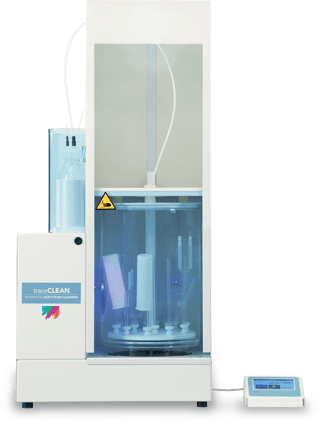
To achieve high-quality blanks when using microwave digestion, pre-cleaning of the vessels is critically important. It is insufficient to simply wash or soak vessel liners in dilute acid. The surface of PTFE is porous and will take up trace amounts of digest solution at elevated temperatures, especially as it “ages” with continued use. Running a blank in a vessel previously used to digest a sample, without thorough cleaning, will lead to blank contamination and degraded detection capability.
There are two ways to thoroughly clean a microwave digestion vessel. The traditional method is to perform a cleaning run (with blank acid) in the microwave prior to each sample digestion run. However, the downside is that this significantly reduces the sample processing capacity of the microwave digester and puts additional wear and tear on the vessels, since it is done at high temperature and pressure. The alternative approach involves placing the vessels in a closed system containing high-purity acid vapors. There are many benefits of this technique over microwave cleaning runs or acid soaking, which are described below.
| The traceCLEAN Acid Reflux Cleaning System
The traceCLEAN from Milestone is an automated acid reflux system that thoroughly and safely cleans microwave digestion vessel liners including TFM, PFA, glass, and quartz. The system is comprised of a heated acid reservoir with a metal-free cleaning chamber above it. The traceCLEAN is based on acid steam cleaning, so only high-purity acid vapor comes into contact with the items to be cleaned. Trace metal contaminants present in the cleaning acid remain in the lower reservoir and do not come in contact with the cleaned items. A built-in exhaust/cooling system prevents operator exposure to acid vapors, allowing the system to be placed outside the fume hood. User safety is ensured through the use of a dedicated interlock which allows for unattended running. A cleaning run typically takes about one hour, and cleaned items are cooled inside the system prior to removal, which prevents airborne contamination. In addition, the traceCLEAN can also be used for cleaning other accessories compatible with acid, including plasma torches and sample introduction components used with ICP-OES and ICP-MS instrumentation.
This method of cleaning is preferred to traditional acid soaking because:
- Trace-metal contamination found in the reagent-grade acid remains in the lower reservoir and does not come in contact with the component to be cleaned.
- The clean component does not remain in contact with the cleaning acid after the surface contamination is removed.
- The critical surfaces of the clean components are nearly dry when the cleaning process is complete, which reduces the need for rinsing and drying.
- The cleaning process takes place in a sealed container, which minimizes airborne contamination and provides a clean environment for the components to be stored until they are needed.
- The clean components are not subjected to high pressure as with microwave cleaning, thus enhancing the component lifetime.
- Increased productivity as the microwave digestion system is used for running samples while the traceCLEAN is dedicated to cleaning vessel components.
Latest Articles

Mastering Geological Sample Preparatione

IMPROVE LABORATORY CLEANING EFFICIENCY WITH TRACECLEAN
